Why Greenhouse Gases Trap Heat- Molecular Spectroscopy Perspective
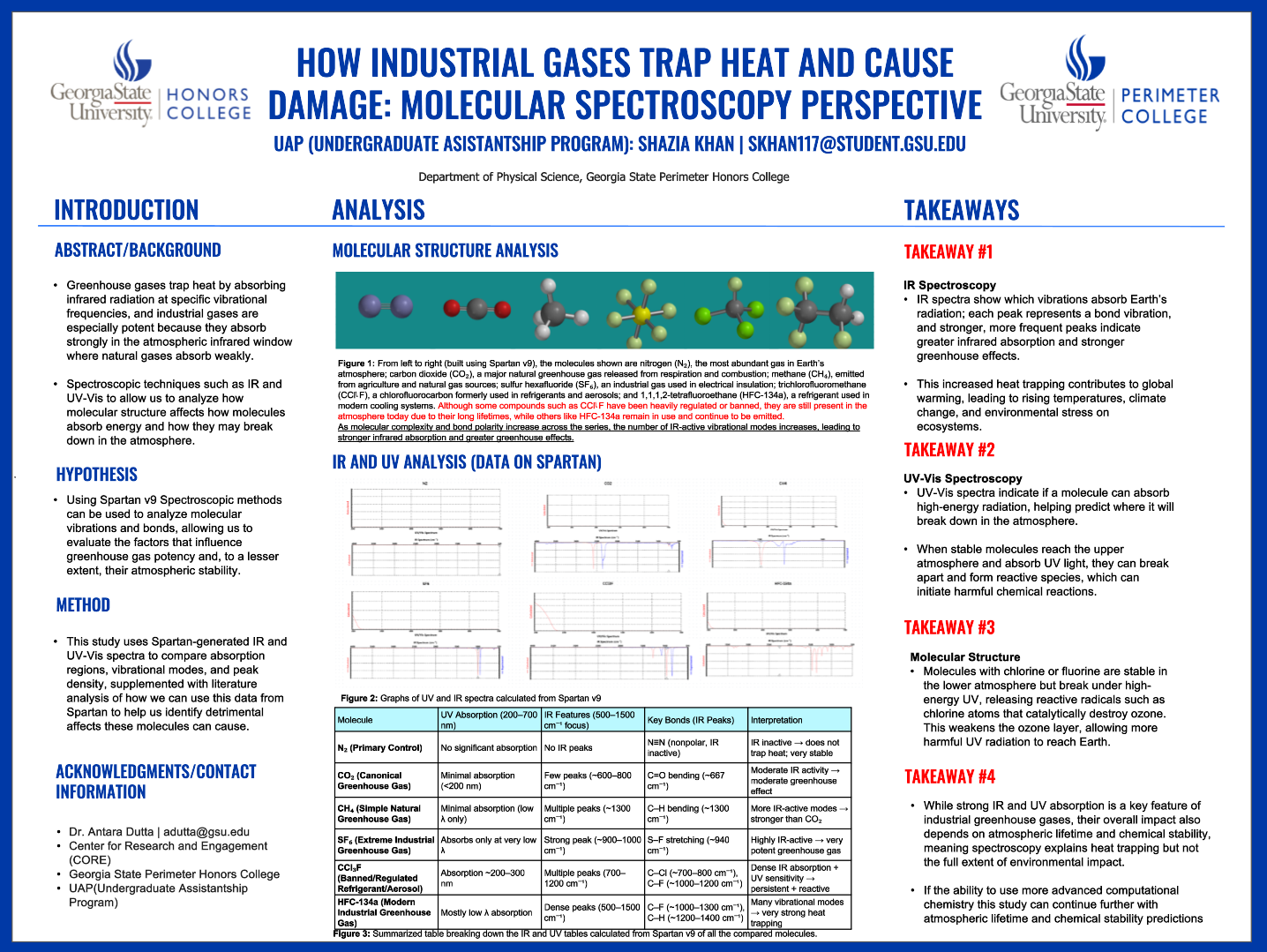
This project explored how molecular spectroscopy can be used to analyze why industrial greenhouse gases exhibit disproportionately strong environmental effects compared to simpler natural gases. Using Spartan-generated IR and UV-Vis spectra, molecular structure analysis, and vibrational mode comparisons, the project investigated how bond polarity, molecular complexity, and IR-active vibrational modes influence a molecule’s ability to absorb infrared radiation and trap heat within Earth’s atmosphere. Molecules including N₂, CO₂, CH₄, SF₆, CCl₃F, and HFC-134a were compared to identify trends in peak density, absorption regions, and molecular behavior.
In addition to greenhouse warming, the project examined how UV-Vis spectroscopy can provide insight into atmospheric persistence and photochemical breakdown. By analyzing UV absorption behavior and molecular structure, the study connected the stability of chlorine- and fluorine-containing industrial gases to their ability to survive in the lower atmosphere and later undergo photodissociation in the stratosphere, releasing reactive radicals that contribute to ozone depletion. This project strengthened my understanding of spectroscopy, atmospheric chemistry, molecular modeling, and environmental analysis while demonstrating how computational chemistry tools can be used to study real-world climate and environmental issues.
Click Me!